Genomics, transcriptomics, and proteomics — taught live with Dr. Ashraf over 60 intensive days in a cohort of driven peers from across Africa.
Everything a bioinformatics career demands — in one live, cohort-based diploma at a price built for African scientists.
From molecular biology fundamentals to advanced GWAS and protein structure prediction — a complete bioinformatics education in one cohort.
Dr. Ashraf delivers every session live. Real-time questions, live coding, and instant feedback — no recorded passivity.
Learn alongside driven researchers from Nigeria, Ghana, Kenya, South Africa, and beyond. Build a network that lasts a career.
Every course includes real pipeline work — FASTQ processing, Python scripting, BLAST searches, and phylogenetic tree building.
Earn a verifiable diploma upon completion, recognised for its rigour across African academic and research institutions.
The full 13-course programme for just $100 — over 55% cheaper than enrolling in individual courses separately.
Programme Director & Lead Instructor
Dr. Ashraf is a computational biologist whose work spans genomics, transcriptomics, and structural bioinformatics. With years of research and training experience across the continent, he has made it his mission to bring world-class bioinformatics education to African scientists — live, rigorous, and affordable.
He designed this diploma to be the programme he wishes had existed when he started out: technically deep, practically grounded, and built for the African research context.
The bedrock of every bioinformatics career.
Master the molecular foundations of life — DNA, RNA, gene regulation, genome evolution — and discover how these biological processes generate the data bioinformatics analyses.
Parse, analyse, and visualise biological sequences like a professional.
Move from reading biology to computing biology. From parsing FASTA files in Python to visualising 3D protein structures — become a confident user of the full bioinformatics ecosystem.
Master the world's biological data — search smarter, find faster.
NCBI, UniProt, PDB, BLAST, Primer3 — become an expert in the databases and tools every bioinformatics researcher uses daily. No more guessing what that E-value means.
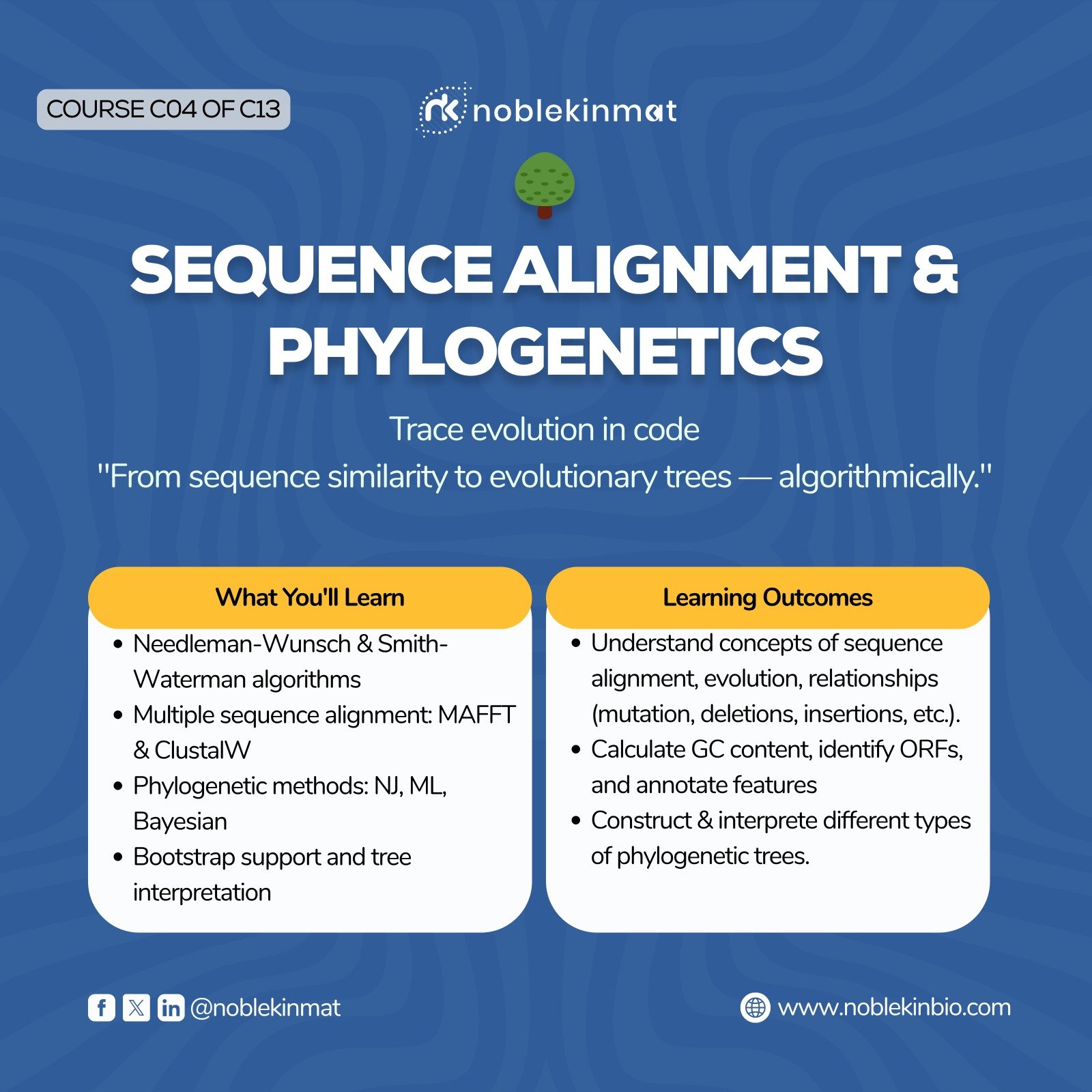
Trace evolution algorithmically — from sequence to tree.
Understand alignment at the algorithmic level and build publication-quality phylogenetic trees. Implement Needleman-Wunsch from scratch AND produce trees used in real publications.
Process a whole genome — from raw FASTQ to annotated variants.
The complete NGS course. From sequencing technology principles to a working FASTQ→VCF pipeline. Run real commands on real data and understand every step GATK is performing.
Python · R · Linux · Snakemake — write code that works in any lab.
The single most important course in the program. By the end you will write production-quality analysis pipelines in Python and R, automate multi-sample workflows with Snakemake, and run jobs on HPC clusters.
Predict protein structures. Dock drugs. Discover molecules.
From a protein sequence to a 3D drug-target complex — computationally. Use AlphaFold2 and AutoDock Vina to do in hours what crystallographers spent years on. This course bridges structural biology and drug discovery.
Decode the transcriptome. Find what changes and why.
Master RNA-seq from raw reads to pathway biology. Run a real DESeq2 analysis, produce publication-quality volcano plots, and map differentially expressed genes onto biological pathways — all from a real published dataset.
From mass spec to molecular networks — identify every protein.
Proteomics is the missing piece of the transcriptomics story. This course teaches you to process quantitative proteomics data, annotate proteins with functional domains, and build interaction networks that reveal how proteins work together in disease.
Find the target. Screen the library. Personalise the treatment.
Apply bioinformatics to the drug discovery pipeline. Build QSAR models, run virtual screening campaigns, and analyse pharmacogenomics data from TCGA — skills that pharmaceutical companies are hiring for globally.
Explore the invisible world hiding in every sample.
The microbiome is one of the fastest-growing fields in biology. This course gives you hands-on proficiency with QIIME2 and Metaphlan4 — the tools used in landmark gut microbiome, soil ecology, and infectious disease studies worldwide.
Train models on genomes. Interpret them with biology.
Galaxy for workflows, scikit-learn for classical ML, TensorFlow for deep learning, SHAP for biological interpretation. Build models that classify cancer subtypes and predict splice sites from DNA sequences.
The most important skills no one teaches you — until now.
Every scientist needs to write, and every scientist needs to be ethical. This course teaches both — following COPE guidelines, NIH data sharing standards, and the writing conventions of top journals like Nature Methods and Genome Biology.
Instead of paying for each course individually — totalling over $200 — enrol in the full diploma and unlock everything for just $100. Live sessions, all materials, cohort network, and your diploma certificate included.
Eight measurable skills that will define your bioinformatics career from day one.
Design and run FASTQ→VCF workflows using GATK, BWA, and SAMtools on real genomics data.
Use DESeq2 and edgeR to identify and interpret differentially expressed genes with biological meaning.
Use AlphaFold2, PyMOL, and molecular docking tools to study proteins at atomic resolution.
Run genome-wide association studies and understand the statistical and biological significance of variants.
Navigate the command line, write bioinformatics scripts, and manage conda environments with fluency.
Process, cluster, and annotate single-cell transcriptomics datasets using Seurat and Scanpy.
Construct maximum-likelihood and Bayesian phylogenetic trees used in real research workflows.
NCBI, UniProt, PDB, Ensembl — query effectively and interpret results with professional confidence.
"Before this diploma, bioinformatics felt like a foreign language. Dr. Ashraf has a rare gift for making complex pipelines feel intuitive. I ran my first GWAS in week four."
"The live cohort format is what makes this different. I now have colleagues in Kenya, Ghana, and South Africa I regularly collaborate with. The network alone is worth the price."
"I had tried other online bioinformatics courses and always dropped off. This cohort kept me accountable. The AlphaFold module blew my mind — I published a paper within three months."
60 days. 13 courses. One cohort of peers who will push you forward. The African bioinformatics community is being built right now — and this diploma is your entry point.